

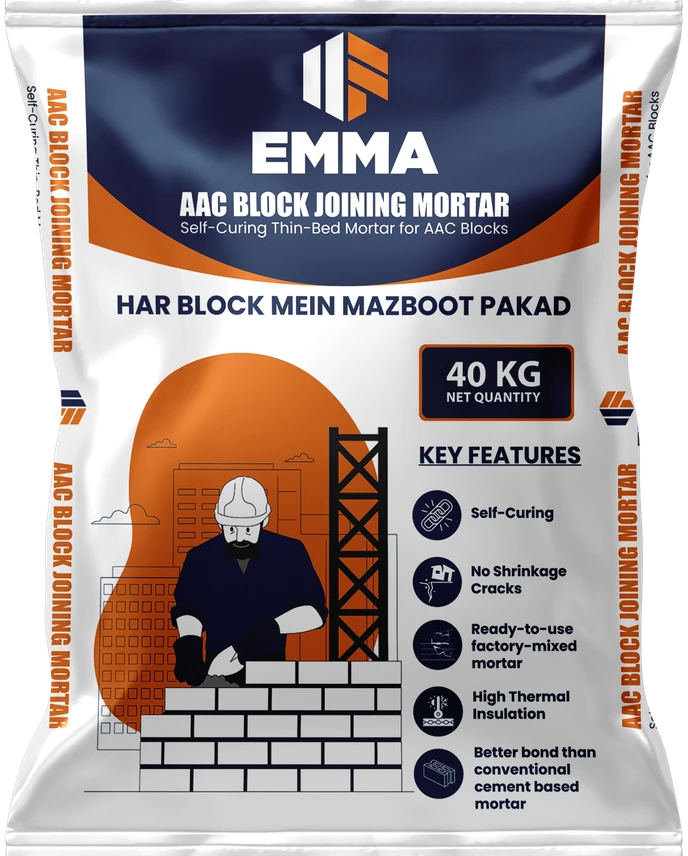
EMMA AAC Block Joining Mortar
EMMA AAC Block Joining Mortar is a thin-bed adhesive designed for AAC, fly-ash and lightweight blocks and bricks. It delivers high bonding strength, precise alignment and crack-resistant performance for both internal and external masonry. Ready to use with just clean water, it cuts construction time and cost while improving wall durability.
Key features
- High bond strength for AAC and lightweight blocks and bricks
- Thin-bed application (2–3 mm) — faster construction, less material
- Crack-resistant with high workability
- No curing required, saving time and water
- Suitable for internal and external walls, residential and commercial
- Reduces construction time and cost, improves wall durability
Suitable for
- Internal and external walls for residential and commercial buildings
- AAC, fly-ash and lightweight block and brick construction
- Projects where speed of masonry and clean joints matter
| Specification | Value |
|---|---|
| Pack size | 40 kg |
| Application thickness | 2–3 mm (thin bed) |
| Curing | Not required |
| Standard | IS 2250, ASTM C1660 / C270 |
| Masonry application | IS 6041:1985 |
| Shelf life | 6 months from manufacture, stored dry |
Compliance: Conforms to IS 2250 and ASTM C1660/C270. Masonry application as per IS 6041:1985. Values are typical results under standard test conditions; site performance varies with substrate, workmanship and weather.
Prepare
Blocks must be clean and free of dust. Lightly damp the surface in dry weather — never soak.
Mix
Add mortar to clean water and mix to a smooth, lump-free paste. Let it stand 5 minutes, then re-mix.
Lay
Spread a 2–3 mm bed with a notched trowel, set the block, tap level with a rubber mallet and check with a spirit level.
Finish
Clean excess mortar from joints before it sets. No curing needed.
Tools: Notched trowel, masonry trowel, rubber mallet, spirit level, line dori. · Full application & tools guide →
Questions about AAC Block Joining Mortar
How many blocks does one 40 kg bag lay?
Does it need water curing like cement mortar?
How thick should the joint be?
Can I use it on fly-ash and concrete blocks too?
Should blocks be soaked before laying?
Does a thin joint reduce wall strength?
Related products
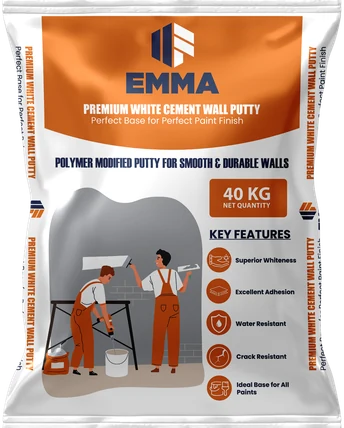
Wall Putty
Polymer Modified Putty for Smooth & Durable Walls
Polymer-modified white cement putty. Fills micro-cracks and gives paint a perfect base.
View details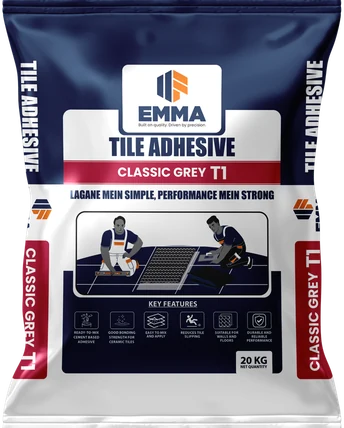
Classic Grey T1
Basic Polymer Modified Adhesive (Type 1)
Everyday interior tiling. Small ceramic wall and floor tiles up to 300×300 mm.
View details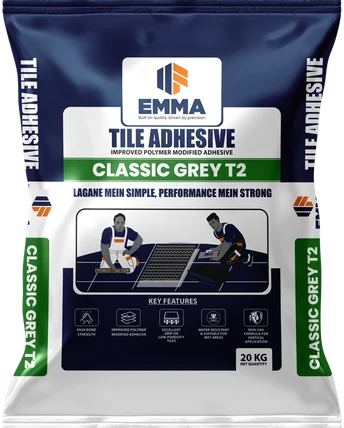
Classic Grey T2
Improved Polymer Modified Adhesive (Type 2)
Vitrified and large ceramic tiles up to 600×600 mm, including tile-on-tile.
View detailsBuilding the Future. Strengthening the Northeast.
Tell us the product, the quantity and the site — our team replies within one working day.