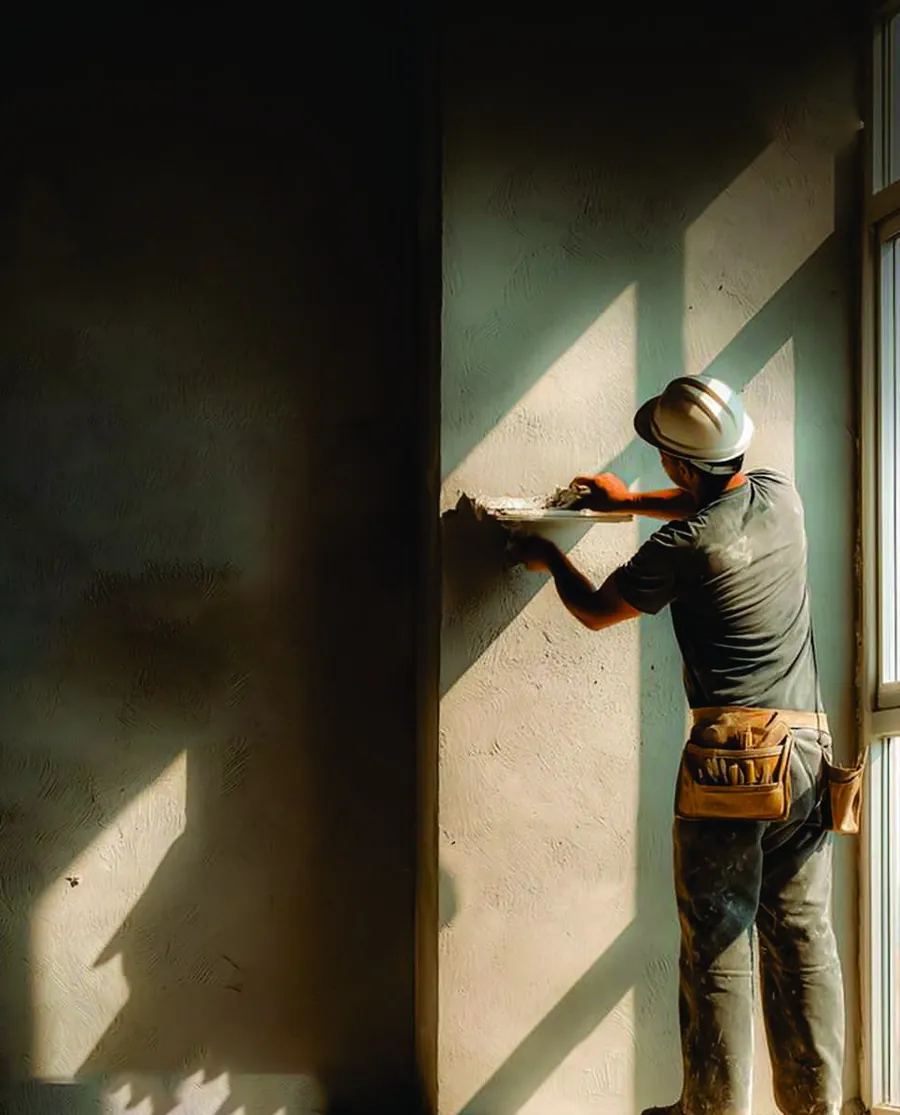
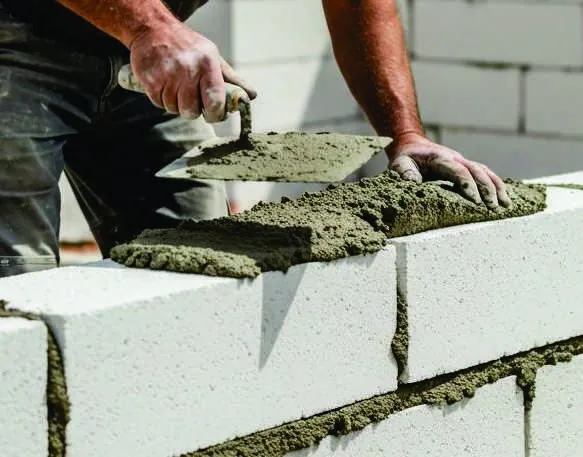
An AAC block is dimensionally accurate to a couple of millimetres. That accuracy is the reason thin bed mortar exists — and the reason laying AAC on a thick cement-sand joint is a wasted opportunity.
Joint thickness changes everything
Cement-sand masonry needs a 10–15 mm joint to absorb the variation in hand-made bricks. AAC blocks do not vary that much, so a 2–3 mm thin bed is enough. That single change cascades:
- Material. One 40 kg bag of thin-bed mortar goes much further than the cement and sand needed for the same wall at 12 mm joints.
- Speed. Thin-bed mortar is combed on and the block is set immediately — a trained mason lays noticeably more wall per day.
- Thermal performance. A 12 mm cement joint is a thermal bridge straight through an insulating block. A 3 mm polymer joint barely registers.
- Water. Thin-bed mortar needs no curing, which matters on upper floors and on sites where water has to be carried.
- Plaster. Flatter walls with thinner joints need less plaster to true up, saving material again.
Strength where it counts
The concern people raise is whether a 3 mm joint can be as strong as a 12 mm one. For AAC masonry it is the wrong comparison — the failure point is not the joint thickness but the bond between mortar and block. A polymer-modified thin-bed mortar bonds to the AAC surface far better than cement-sand mortar, which sits on the block and pulls moisture out of itself into the porous block, weakening as it goes.
Laying it correctly
- Blocks must be clean and free of dust. In dry weather, dampen the surface lightly — never soak it.
- Mix to a smooth, lump-free paste with clean water, let it stand five minutes, re-mix.
- Comb a 2–3 mm bed on the bed face and the vertical face.
- Set the block, tap level with a rubber mallet, check line and level with a spirit level and line dori.
- Strike excess mortar from the joint before it sets. No water curing needed.
Where the savings actually land
Costed per bag, thin-bed mortar looks more expensive than cement and sand. Costed per square metre of finished wall — including sand, cement, mixing labour, curing water, masonry time and the plaster saved on a straighter wall — it generally comes out level or ahead, and the wall is finished days earlier.
Standards
Thin-bed mortar for AAC conforms to IS 2250 with ASTM C1660 and C270 references, and masonry application practice follows IS 6041:1985. Specify both in your tender documents so the method is agreed before work starts.
Read next
- Tile Adhesive vs Cement Mortar: Which Is Better for Fixing Tiles?
- Tile Adhesive Type 1, Type 2 and Type 3: What the Difference Actually Means
- Tile Adhesive Coverage: How Many Bags per 100 sq ft?
Browse the full EMMA product range, check the application guide, or ask our technical team about your site.