
Bahar ki tiles gir rahi hain?
Exterior elevation tiles falling off the wall
SOL 05 · Updated 26 November 2026 · EMMA Technical Desk
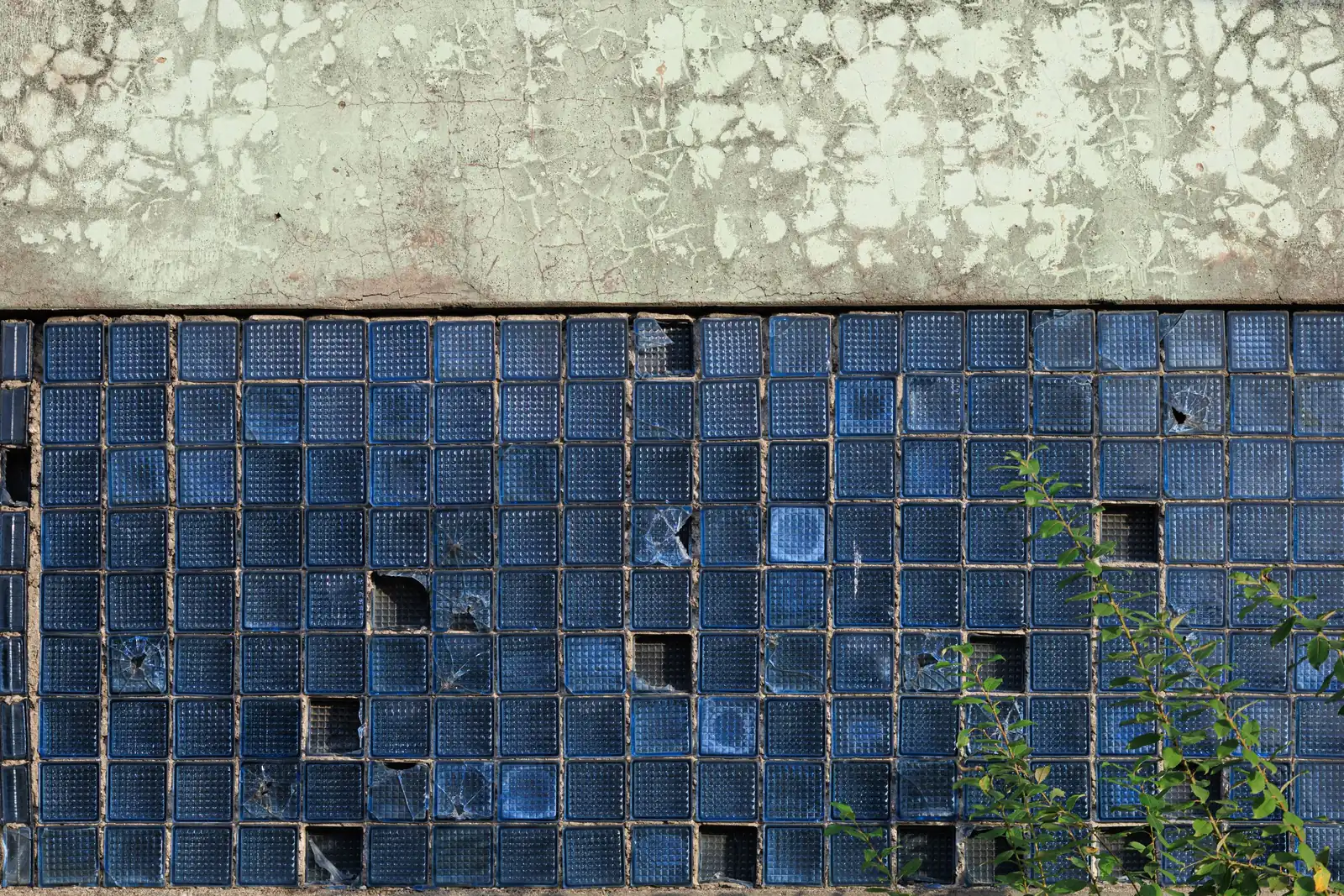
Stock photo for illustration only.
Short answer. Elevation tiles usually fall because they were fixed with cement mortar or an interior-grade adhesive that cannot cope with sun, rain and the wall's movement, or because water got behind them through open joints. Remove every loose or hollow tile in the area, repair and clean the wall, and relay the tiles in a full bed of a Type 3 adhesive. Use Classic Grey T3, whose catalogue entry lists extreme weather exposure, or Maxi Plus White T3, whose entry lists facades and exterior cladding; EMMA's guidance keeps the T1 and T2 grades off facades.
Why it happens
An outside wall works harder than any floor. In the afternoon sun a dark tile heats up faster than the wall behind it, and a monsoon shower cools it in minutes. Each cycle pushes and pulls on the bond. Over a few years a weak bond fatigues and lets go, and gravity does the rest.
The weak bonds have familiar causes. Tiles were fixed on dabs of cement mortar, so only part of each tile was held. The adhesive was a grade meant for indoor floors. It was spread across a hot wall in wind and skinned over before the tiles went on. Joints were left half filled, so rain ran in behind the tiles and stayed there.
The wall itself can be the cause. Plaster that was already hollow, cracks in the masonry, or a frame that moves between floors will take the tiles with them. Long runs of tiles with no movement joints at floor levels and corners build up stress until something cracks.
A falling tile can injure someone. Treat a facade with loose tiles as a safety problem first.
Choosing the grade matters more outside than in. EMMA's catalogue lists Classic Grey T3 for exterior walls and for exposure to heavy rain and direct sunlight, and Maxi Plus White T3 for exterior cladding and facades. EMMA's guidance keeps the T1 and T2 grades off facades and weather-exposed elevations. On an elevation in the Northeast, where walls take both strong sun and long monsoon spells, the Type 3 grades are the ones to use.
When the wall needs repair first
If the plaster behind the fallen tiles is hollow or crumbling, if there are cracks running through the masonry, or if the same area keeps failing, relaying tiles on that surface repeats the failure. Have the wall and its plaster repaired, and ask a structural engineer about cracks that run through the masonry.
Step-by-step fix
- Make it safe. Cordon off the area below and work from proper scaffolding. Remove tiles that are about to fall before anything else.
- Find the water route. Look for open or cracked joints, gaps at window frames and parapets, and leaking downpipes. Seal these routes as part of the repair so rain stops reaching the back of the tiles.
- Sound the whole elevation. Tap every tile within reach and mark the hollow ones. Remove them and a margin of tiles around each patch.
- Repair the backing. Hack off hollow or crumbling plaster, repair cracks with suitable materials and let repairs harden. Brush off dust and loose particles so the surface is sound and clean.
- Clean any tiles you reuse. Tiles that came off with old mortar stuck to the back cannot bond properly. Scrape and wash the backs back to the bare tile, or use new tiles of the same size and thickness.
- Mix a Type 3 grade. Mix Classic Grey T3 or Maxi Plus White T3 with clean water only, with no cement or sand added. Use the mix within its pot life of 2–2.5 hours.
- Fix in a full bed. Comb the adhesive on with a notched trowel and set tiles within the open time of 30–35 minutes, working in shade where you can. Back-butter tiles larger than 600 × 600 mm, as the Maxi Plus White T3 method states. Protect fresh work from rain during application.
- Keep movement joints. Leave movement joints at floor levels, corners and changes of material, filled with a flexible sealant instead of grout.
- Grout completely. With Maxi Plus White T3, grout after 24 hours. The Classic Grey method allows 24–72 hours of curing before grouting. Fill joints fully so rain cannot get behind the tiles.
Recommended EMMA products
These grades are the ones EMMA's catalogue lists for this job. Pick by tile type and where it is going.
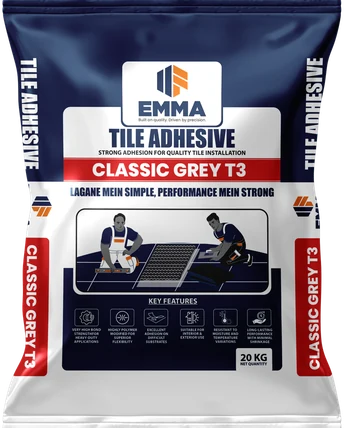
Classic Grey T3
Listed for exterior walls, concrete substrates and extreme weather exposure such as heavy rain and direct sunlight. Large-format tiles and natural stone.
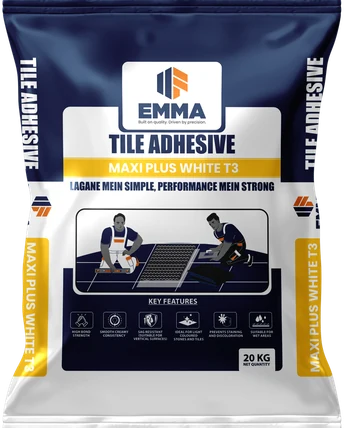
Maxi Plus White T3
Listed for exterior cladding, facades and high-rise buildings. White and non-staining for marble, light stone and glass mosaic.
What EMMA does not cover. EMMA has no product that refixes a loose or hollow elevation tile from outside, and does not make wall repair mortars, sealants or water-repellent coatings. The affected tiles have to be removed and relaid, and cracks or hollow plaster behind them need repair with suitable materials first.
Key facts
- Adhesive class
- IS 15477:2019 Type 3
- EMMA grades for exterior walls
- Classic Grey T3, Maxi Plus White T3
- Not for facades
- Classic Grey T1, T2; Maxi Plus White T1, T2
- Open time
- 30–35 mins
- Pot life
- 2–2.5 hrs
- Back-buttering (Maxi Plus White T3 method)
- Tiles larger than 600 × 600 mm
- Rain (Maxi Plus White T3 method)
- Protect from rain during application
- Grouting (Maxi Plus White T3)
- After 24 hours
- Curing (Classic Grey)
- 24–72 hours before grouting / use
Figures from the EMMA product catalogue 2026-27. Coverage and timings are indicative and depend on substrate, applicator and weather.
 AAC Block Joining Mortar
 Wall Putty
 Classic Grey T1
 Classic Grey T2
 Maxi Plus White T1
 Maxi Plus White T2