
Badi tiles hil rahi hain ya khokhli lag rahi hain?
Large-format tiles that are loose or sound hollow
SOL 03 · Updated 26 November 2026 · EMMA Technical Desk
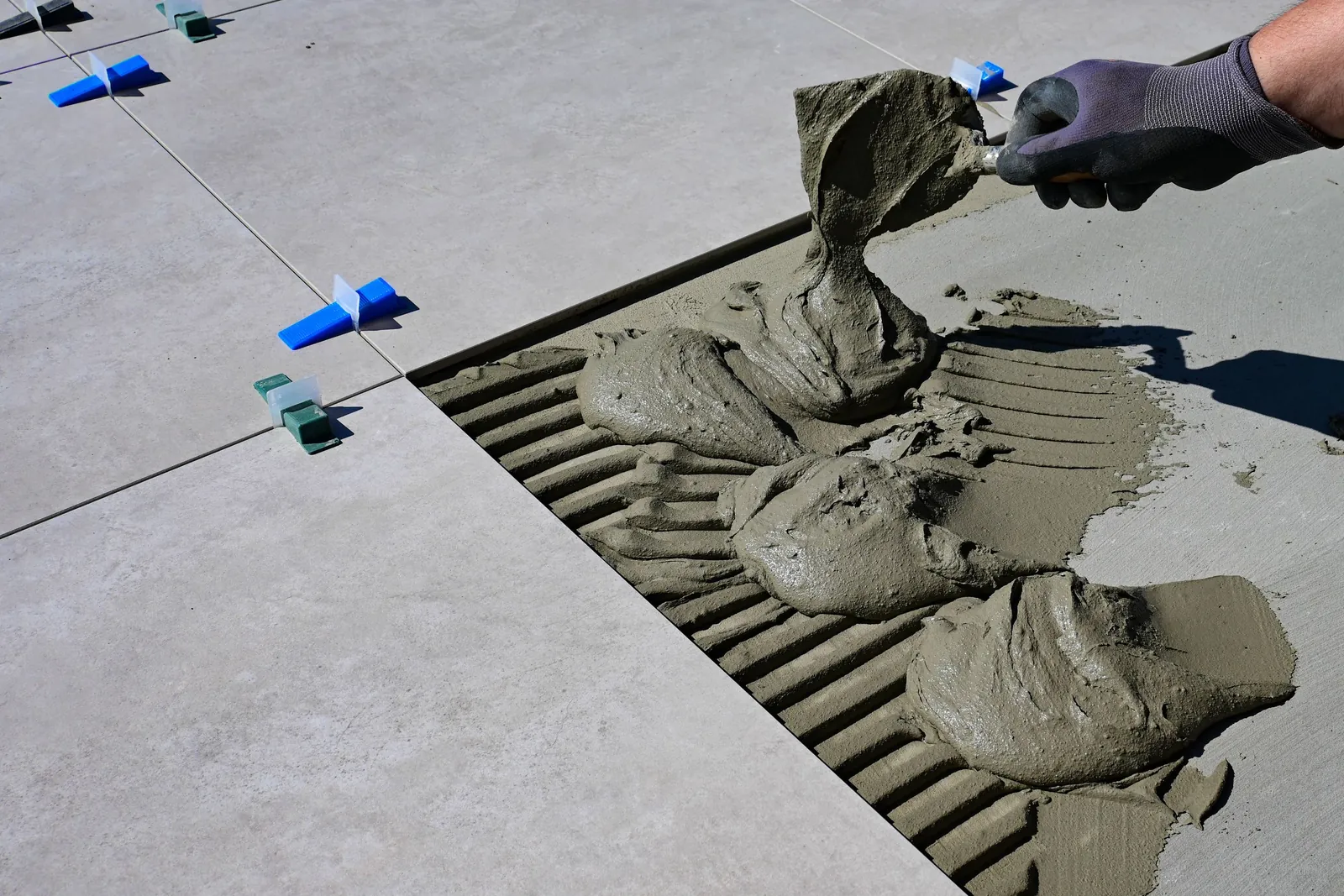
Stock photo for illustration only.
Short answer. Large tiles go hollow when there are air pockets under them, usually from fixing on spots of cement mortar or on an adhesive bed that was too thin or had skinned over. Lift the loose tiles, clean off the old bed and relay them in a full bed of a high-strength adhesive, with adhesive on the back of the tile as well as the floor. EMMA's catalogue lists Classic Grey T3 and Maxi Plus White T3 for large-format tiles; Classic Grey T2 covers tiles generally up to 600 × 1200 mm.
Why it happens
A 600 × 1200 mm tile is long, stiff and heavy, and it is never perfectly flat. Many large tiles have a slight curve, and the floor under them has its own dips. A small tile sits down into a bed of mortar and finds support. A large tile bridges the low spots and leaves gaps under its corners and edges.
The common site habits make it worse. Cement-sand spot fixing gives the tile five or six points of contact with air in between. Adhesive combed with a small notch, or spread over a whole room before the tiles go down, leaves ridges that have dried on top and do not flatten when the tile is pressed in. Skipping back-buttering leaves the dips in the tile's back unfilled.
Movement finishes the job. Floors expand in the sun from a large window and contract at night. Without a gap at the walls and movement joints across large areas, the tiles push against each other. A tile with poor support underneath is the one that cracks, rocks or lifts first.
Levelling clips, like the blue ones in the photo, help keep the faces of neighbouring tiles flush. They do not put adhesive where there is none. A floor laid with clips can still sound hollow if the bed under each tile is patchy, so check coverage as you go rather than trusting the finished surface.
Grade matters as tiles get bigger, because a long tile puts more load on its bond when it moves. EMMA's catalogue lists the Type 3 grades, Classic Grey T3 and Maxi Plus White T3, for large-format tiles, and limits Classic Grey T2 to tiles generally up to 600 × 1200 mm.
When relaying the tiles is not enough
If whole rows lift in a ridge, if cracks run across several tiles in a line, or if the screed under a lifted tile is crumbly or cracked, the fault is below the tiles. Repair or relay the screed, and add movement joints, before you fix tiles again.
Step-by-step fix
- Map the hollow area. Tap every tile with a coin or a rubber mallet and mark the dull-sounding ones. Check the tiles around them as well, since hollow tiles usually come in groups.
- Lift without damage. Cut out the grout around each loose tile and lift it carefully with a suction lifter or a flat bar under a padded edge. Large tiles crack easily when levered from one corner.
- Clean both faces. Scrape the old mortar or adhesive off the floor and the back of the tile until both are flat, sound and free of dust.
- Check the floor is flat. Lay a long straightedge across the bare area in several directions. Fill and level dips with a suitable levelling material first rather than building them up with adhesive.
- Spread a full bed. Mix the EMMA adhesive with clean water only, without adding cement or sand. Comb it on with a large notched trowel and lay tiles within the open time of 30–35 minutes. The Maxi Plus White T3 method calls for adhesive on both the floor and the tile back for tiles larger than 600 × 600 mm.
- Bed and check. Press each tile down and slide it slightly across the ridges to collapse them. Lift the first tile to check the back is fully covered, and keep a gap at the walls.
- Grout at the right time. With Maxi Plus White T3, grout after 24 hours. With Classic Grey T2 or T3, allow 24–72 hours of curing, depending on traffic, before grouting or use.
Recommended EMMA products
These grades are the ones EMMA's catalogue lists for this job. Pick by tile type and where it is going.
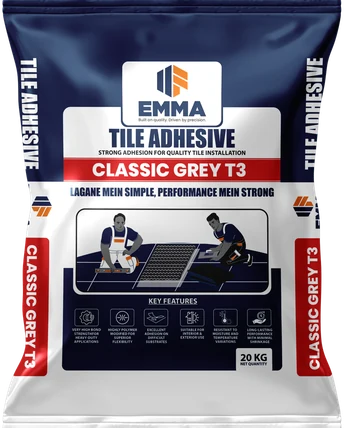
Classic Grey T3
Large-format vitrified tiles, granite, marble and other natural stone, high-traffic floors and exterior walls. Very high bond strength and flexible.
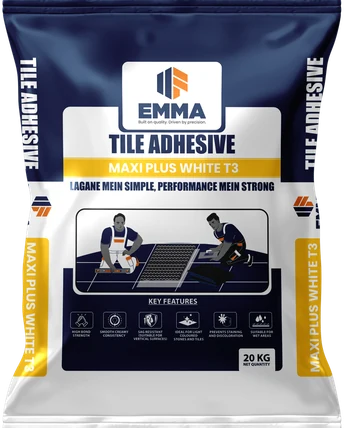
Maxi Plus White T3
A white, non-staining bed for large-format porcelain, white marble, granite and engineered stone. Its method includes back-buttering above 600 × 600 mm.
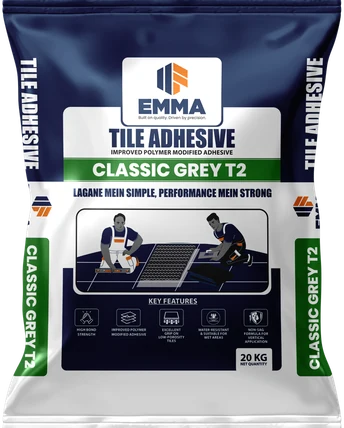
Classic Grey T2
Large ceramic and vitrified tiles generally up to 600 × 1200 mm on indoor and outdoor floors and walls with moderate traffic.
What EMMA does not cover. EMMA has no injection or grouting product that refixes a hollow tile from above, and does not make floor levelling compounds. Loose tiles have to be lifted and relaid, and a cracked or uneven screed needs repair with a suitable material before EMMA adhesive goes on.
Key facts
- Adhesive class
- IS 15477:2019 Type 3 for large-format tiles
- EMMA grades for large-format
- Classic Grey T3, Maxi Plus White T3
- Classic Grey T2 tile size
- Generally up to 600 × 1200 mm
- Back-buttering (Maxi Plus White T3 method)
- Tiles larger than 600 × 600 mm
- Open time
- 30–35 mins
- Pot life
- 2–2.5 hrs
- Coverage (indicative)
- 20–30 sq ft per 20 kg bag
- Grouting (Maxi Plus White T3)
- After 24 hours
- Curing (Classic Grey)
- 24–72 hours before grouting / use
Figures from the EMMA product catalogue 2026-27. Coverage and timings are indicative and depend on substrate, applicator and weather.
 AAC Block Joining Mortar
 Wall Putty
 Classic Grey T1
 Maxi Plus White T1
 Maxi Plus White T2